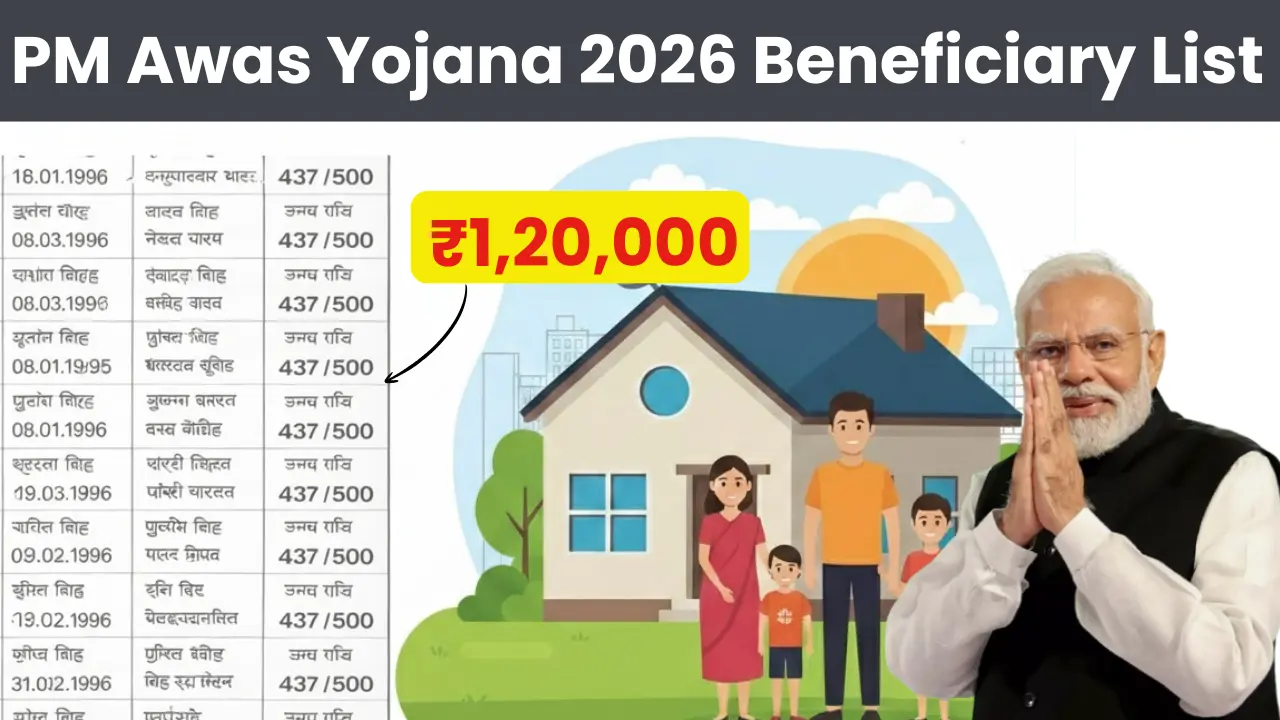
PM Awas Yojana The announcement of the PM Awas Yojana 2026 new beneficiary list has brought renewed attention to one of India’s most important rural welfare schemes. For many low-income families living in temporary huts, mud houses, or unsafe shelters, this list is not just an online update but a symbol of hope for permanent housing. The Pradhan Mantri Awas Yojana (PMAY), especially its rural segment, continues to play a major role in the government’s long-term goal of ensuring safe housing for every citizen. Each new list gives thousands of families the possibility of moving from uncertainty to stability.
PM Awas Yojana 2026 – Key Information Table
| Feature | Details |
|---|---|
| Scheme Name | Pradhan Mantri Awas Yojana (Rural) |
| Financial Assistance | ₹1.20 Lakh (Plain Areas) |
| Higher Assistance Regions | Up to ₹1.30 Lakh or more (Hilly/NE Areas) |
| Payment Method | Direct Benefit Transfer (DBT) |
| Fund Release | Installments based on construction stages |
| Eligibility | Families without pucca houses, SECC-based priority |
| Exclusions | Income taxpayers, govt employees, pucca house owners |
| Verification Levels | Panchayat → District → State |
| Additional Benefits | Toilet, LPG, Electricity, Water convergence |
| List Checking Method | Official Portal / CSC Centres |
Why the 2026 Beneficiary List Is Important
The timing of the updated list is especially meaningful due to the rising cost of construction materials such as cement, bricks, steel, and transportation. For families relying on daily wages or seasonal farming income, building a permanent house without support is often impossible. Inflation has widened the gap between aspiration and affordability, making government assistance more crucial than ever.
Also Read


The continued release of beneficiary lists also signals that housing remains a policy priority despite financial pressures on public budgets. A stable home is not only about shelter; it influences health conditions, children’s education, personal safety, and employment opportunities. Rural development experts frequently highlight that secure housing reduces forced migration and helps families invest more confidently in their future.
Structure and Funding of PM Awas Yojana 2026
Under the rural component of PMAY, financial assistance is transferred directly to beneficiaries through the Direct Benefit Transfer (DBT) system. This eliminates intermediaries and ensures that funds reach the correct bank account. The sanctioned amount is generally ₹1.20 lakh in plain areas, while families in hilly, northeastern, or geographically challenging regions may receive up to ₹1.30 lakh or slightly more, depending on state provisions.
Funds are released in stages linked to construction progress. Beneficiaries receive installments only after verification of each building phase, which encourages responsible use of money and prevents misuse. Another notable feature of PMAY is its convergence with other welfare initiatives. Beneficiary households often receive support for toilets, electricity connections, clean cooking fuel, and drinking water through associated schemes. This integrated model improves overall living standards rather than just providing walls and a roof.
Eligibility Criteria and Selection Process
The eligibility rules of PM Awas Yojana 2026 focus on socio-economic vulnerability. Priority is given to families without permanent housing or those listed under deprivation categories in government socio-economic surveys. Households already owning a pucca house, paying income tax, or working in government jobs are automatically excluded to maintain fairness in allocation.
The selection procedure involves several verification layers. Local village bodies first recommend eligible names, followed by checks at block, district, and state levels. Digitization has reduced the scope for manual bias or favoritism that was once a concern. Geo-tagged photographs, Aadhaar verification, and digital payment tracking have strengthened transparency. Although minor complaints still arise in some regions, the system has improved significantly compared to earlier housing schemes.
How to Check the PMAY 2026 Beneficiary List
Applicants who previously submitted applications can verify their status through the official PMAY portal or by visiting nearby Common Service Centres (CSCs). The search process usually requires a registration number or selection of state, district, block, and village details. Local administrations are encouraging rural citizens to rely only on official channels to avoid confusion or misinformation.
Authorities have also warned against fraud and middlemen who promise faster approvals in exchange for money. Since payments are directly credited to bank accounts, there is no need to pay commissions or service fees. Beneficiaries are advised to keep their personal and banking information secure and to respond only to verified government communications.
Economic and Social Impact in Rural Areas
The influence of PM Awas Yojana extends beyond individual families. Construction activities generate employment for local masons, labourers, transporters, and small material suppliers. During peak building seasons, villages often experience short-term economic boosts as money circulates within the local market. This indirect benefit strengthens rural economies and supports micro-businesses.
On a social level, owning a permanent house enhances dignity and community standing. Secure housing improves sanitation, protects families from harsh weather, and increases safety for women, children, and the elderly. Independent policy studies suggest that families who shift into permanent homes show better health outcomes and greater financial confidence. As the scheme progresses, experts expect stricter verification measures and possible revisions in financial limits to match rising construction expenses.